Showing posts with label Canning. Show all posts

Sunday, May 9, 2010

Rhubarb Marmalade

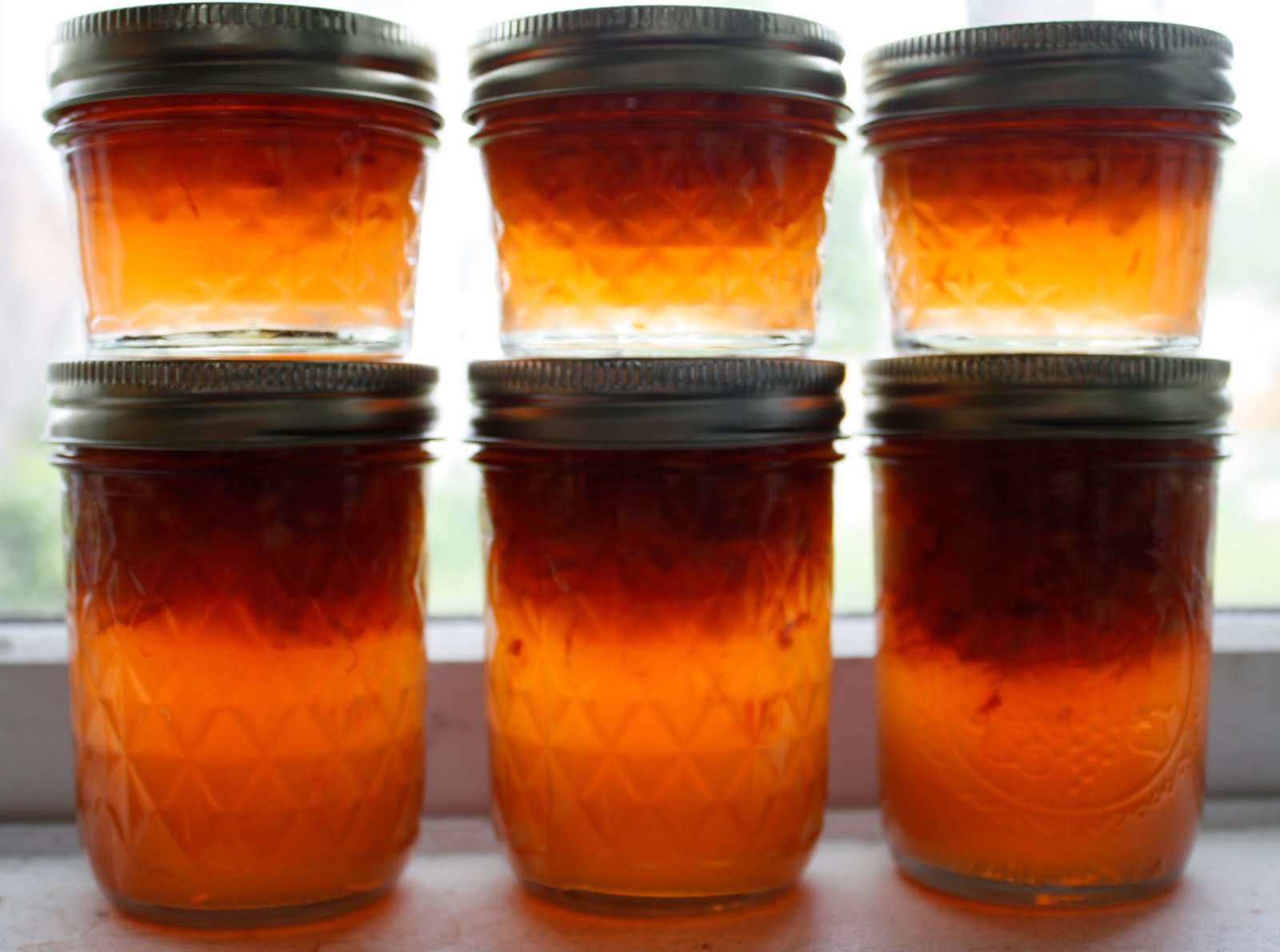
I had this idea to make a rhubarb marmalade the other day and promptly went out, bought some stalks of ruby red rhubarb, a couple Cara Cara oranges, a few lemons and set about canning for the first time in a long time.

I have made marmalades three different times with mixed levels of disaster: Once, a clementine marmalade which never set up, despite my use of pectin. It was so liquidy that I marketed it to my friends as orangey goodness sauce. I made a grapefruit marmalade that was a bit better but saucy nonetheless. And now, this rhubarb marmalade that is decidedly un-saucy but for whatever reason separated in the jars so the rhubarb floated to the top and the jelly settled on the bottom.

I almost didn't post this out of canning shame but the way I see it, nothing is ever perfect, it tastes super good, and it actually looks kind of cool all layered and wrong in the jars. Oh well. I hand the jars to my devoted friends and say "just stir it, ok?"

For 8 half-pint jars:
  • 3½ cups finely chopped rhubarb
  • 3 oranges
  • 1 large lemon
  • ½ cup water
  • 1 tablespoon lemon juice
  • 7 cups sugar
  • ½ teaspoon unsalted butter
  • 1 packet liquid pectin

Wash the oranges and lemon well. Slice off the peels with a sharp paring knife avoiding the pith and then cut the peel into thin strips or use a citrus zester. Set the peels aside. Cut off the pithy part of the fruit, and then cut out each citrus segment. Set aside.

In a large, 8 quart pot, combine the peels, water, and rhubarb. Bring to a boil, lower the heat, cover and simmer for 15 minutes. Add the reserved citrus segments and sugar and stir constantly over medium heat until dissolved. Add the lemon juice and butter. Turn the heat to medium-high and stirring constantly, let the mixture come to a full, rolling boil. Quickly squeeze in the pectin, and stir briskly for one minute. Take the pot off the heat and set a timer for 5 minutes. Each minute, stir the mixture gently to distribute the fruit throughout the jelly.

Ladle the jam into the prepared, hot, sterilized jars and process in a water bath for 10 minutes. For detailed canning and sterilization procedures, click here.

Friday, October 16, 2009

Spicy Calvados Applesauce

Applesauce is one of those things that is so simple to make at home that it should be scratched off your grocery list for good. It goes without saying that homemade sauce is far superior to store-bought, particularly because of the complexity created by using different apple varieties, spices and flavors.

As I detailed in my apple chips post, I find apples and five-spice powder to be a match made in heaven. It works as a mysterious, subtle spice in applesauce also but feel free to substitute cinnamon, nutmeg, etc.

I love the deluxe addition of the French apple brandy, Calvados. It imparts a richness without any overt alcohol flavor. Calvados is so good in so many things: pork dishes, whipped cream, brushed onto an apple tart, and so on. It's on the spendy side but I find that I use it sparingly so my bottle has lasted for quite a while.

If you don't want to go through the trouble of canning the applesauce, it can be portioned out into freezer bags or containers and frozen, for up to 6 months.

For about 5 pints:

  • 8 pounds apples (I used a combination of Haralson, Gala and Prairie Spy)
  • 1 cup water
  • 1 - 1½ cups sugar
  • 1 lemon
  • 1 teaspoon five-spice powder
  • Pinch of sea salt
  • 1/3 cup Calvados

Peel and cut the apples into 2-inch chunks and add them to a large pot. Zest and juice the lemon over the apples.

Over medium-high heat, add the water and one cup of the sugar to the pot with the apples. Stir frequently until the apples are soft, about 20 minutes. Turn the heat down to low and mash the apples with a potato masher until the desired consistency is reached. Stir in the five-spice powder, sea salt, and Calvados. Taste, and add up to a half cup more sugar depending on the desired level of sweetness. Stirring frequently to prevent scorching, raise the heat to medium-high and bring the sauce to a boil. Allow it to boil for one minute, stirring constantly, and then remove from the heat.

Have five sterilized pint canning jars ready. Fill the jars, leaving a 1/2-inch headspace. Run a plastic knife down the center of the jar and around the inside to remove any air bubbles. Process the jars in a lightly boiling water bath canner (about 200 degrees) for 20 minutes. Remove the jars from the water and set aside to cool for 24 hours before storing in a cool, dark location for up to a year.

For complete sterilization and canning procedures, click here.

Monday, September 7, 2009

Peach Ginger Conserve

Conserves, which are essentially jams containing dried fruits and nuts, have scared me for a long time. Believe me, I had clear reasons. One, I had never heard of such a thing until I started reading up on canning. Two, I had never had a conserve served to me nor had I ever seen it in a store. Three, I was apprehensive about the idea of nuts and raisins in my jam. My conserve-fear was irrational for it is a glorious thing.

Conserves were popular in old-timey days as a condiment for meat - which I am guessing means it served as a cover for questionable meat that had maybe not seen its freshest days. These days though, I serve it the same way as I would a jam and discovered it made a particularly good crepe filling. There's really no going wrong when peaches, ginger, brandy, raisins, almonds and a hint of orange are combined. So, so good.

For about 8 half-pint jars:
  • 1/2 cup golden raisins
  • 1/3 cup minced crystallized ginger
  • 1/2 cup brandy
  • 3 cups of pitted, peeled and crushed ripe peaches
  • 2 lemons, juiced
  • 6 cups sugar
  • The zest of 1 orange
  • 1/2 teaspoon unsalted butter
  • 2 pouches liquid pectin
  • 3/4 cup very lightly toasted sliced almonds

In a bowl combine the raisins, ginger and the 1/2 cup of brandy. Place in the microwave for 30-45 seconds and set aside while the rest of the ingredients are being prepped.

In an 8-quart pot stir together the peaches, lemon juice, sugar, orange zest, and butter. Drain the brandy off of the raisins and ginger and add them to the pot, reserving the brandy for later. Cook over low heat, stirring constantly until the sugar dissolves. Bring the heat up to medium-high and cook, stirring constantly to prevent scorching. When the mixture comes to a full boil, quickly squeeze both pouches of pectin into the pot and stir for 1 minute. Take the pot off the heat.

Set a timer for 5 minutes and stir in the almonds and a 1/3 cup of the reserved brandy. Stir the conserve once or twice every minute for 5 minutes to distribute the ingredients evenly through the syrup.

Ladle the jam into prepared, hot, sterilized jars and process in a water bath for 10 minutes at 200 degrees. For detailed canning and sterilization procedures, click here.

Adapted from a recipe in Blue Ribbon Preserves by Linda Amendt.

Sunday, August 30, 2009

True Blue

Last year I submitted my Rhubarb Raspberry Jam to the Minnesota State Fair and won a blue ribbon. This was my first time submitting anything so not only was this unexpected, it turned out to be fun as hell. Gabbing with the veteran canners, receiving my prize money in the mail ($12-ha!), and of course, going and seeing my jam displayed behind the glass case makes me happy to think about even now.

Since then I have been both slightly terrified and more determined about this year's fair. The prospect of not winning, which in my mind would have made last year's win a wretched fluke drove me to stack the competition deck and submit 7 entries this year. I canned and canned and canned, hoping not for a blue ribbon, but for any ribbon - red, white or pink would suit me just fine.

The morning of the first day of the fair, The Chef and I were up early, continuously refreshing the Fair's canning results page. When it finally posted I was ecstatic and relieved to see I had won a blue ribbon for my Blueberry Jam. As we scrolled through the rest of the results, I couldn't believe my eyes when I saw I had won a second blue ribbon for my Peach Jam. The Chef and I did a little victory dance in the living room which got the dogs barking and I couldn't help but think to myself - I might actually be good at this.

Over the years I have had varying degrees of success with the jams, fruit butters, fruit syrups, and marmalades I have canned. Fortunately I have a close group of friends that I can hand a jar of something to with the warning "this isn't that awesome but you should eat it anyway" or "this was supposed to be marmalade but now I'm calling it sauce." These friends have loyally brought the questionable items home and reported back with gratifying tales of sauce-as-cake filling, sauce-as-pancake syrup, sauce-as-ice cream topping, etc.

I still can't say I love canning - the mess, the heat, the mountains of dirty dishes - but when I'm down in the basement and see a row of jars on the shelf, waiting to be eaten, or gifted, or submitted to the Fair, I'm happy.

Tuesday, July 21, 2009

Four Berry Jam

Us Minnesotans have been annoyed as of late that strange, Autumn-like weather descended upon us, bringing cold, cloudy gray days right smack in the middle of July. I knew that this cool weather provided optimal conditions for my least favorite hobby so, comforted by the knowledge that I wouldn't be sweating over pots of boiling jam and water, I set off to can the afternoon away.

I can't give the exact proportions of each type of berry used but can say that for this jam, you will need 5 cups of crushed fruit. What I ended up doing was crushing a single layer of each fruit (which is always how you should crush fruit for jams to ensure uniform texture) and then added it to a large measuring cup, repeating until 5 cups was reached. The end result was tasty indeed: dark burgundy in color with a rich berry flavor.

For 8 Half Pint Jars:
  • Strawberries, stemmed, cored, and quartered
  • Blackberries
  • Raspberries (I pushed half of the crushed raspberries through a sieve to take out some seeds)
  • Blueberries
  • 2 tablespoons fresh strained lemon juice
  • 1/2 teaspoon unsalted butter
  • 7 cups sugar
  • 1 package liquid pectin

In a large 8-quart pot, combine the 5 cups of crushed berries, lemon juice, butter and sugar over low heat. Start stirring the mixture, turning the heat up in small increments until all the sugar is dissolved, not bringing the heat up past medium. Turn the heat to medium-high and stirring constantly, let the mixture come to a full, rolling boil. Quickly squeeze in the pectin, and stir briskly for one minute. Take the pot off the heat and set a timer for 5 minutes. Each minute, stir the mixture gently to distribute the fruit throughout the jelly.

Ladle the jam into the prepared, hot, sterilized jars and process in a water bath for 10 minutes.

For detailed canning and sterilization procedures, click here.

Saturday, May 30, 2009

Rhubarb Strawberry Jam

I had taken a much needed respite from canning but now that May is almost behind us, I need to start up my least favorite hobby again. I always am pleased when I have made something and have jewel-colored jars sitting in front of me. It's the lengthy, messy, exacting process of it all that gets me, not to mention that canning in the summer months with a vat of boiling water steaming up at me in my hot old house isn't even marginally pleasant.

Ah, but, there is the Minnesota State Fair to consider. Last year, I won a blue ribbon for my Rhubarb Raspberry Jam which was way too much fun. I am trying not to envision a ribbonless, sophomore slump season ahead of me which is why I continue to can and hope for the best.

Now, I am not going to attempt to provide detailed canning instructions since I found a great tutorial here. The recipe below is for the amounts and general method I used, but proper waterbath canning and sterilization procedures must be followed.

I have never made this particular flavor jam before and am happy to say it is delicious. The color is exceptionally exquisite and the flavor is fresh and very fruity.

For about 7 half pint jars:
  • 2½ cups of finely diced rhubarb (the pieces should be about the size of a pencil eraser)
  • 2 cups of chopped and crushed strawberries
  • The strained juice of one small lemon
  • 6½ cups sugar
  • 1/2 teaspoon unsalted butter
  • 1 pouch Certo Liquid Pectin (3 ounces)

In a big heavy 8-quart pot, combine the rhubarb, strawberries, lemon juice and sugar. Stir together, cover and set aside for 2-3 hours, giving it a stir once or twice.

Remove the cover and over low heat, start stirring the mixture, turning the heat up in small increments until all the sugar is dissolved. If the mixture is heated too quickly, the sugar can crystallize in the jar later. It took about 40 minutes for my mixture to fully dissolve. At this point, stir in the butter, which helps prevent air bubbles, turn the heat to almost high and stir constantly. Once the mixture comes to a full, rolling boil, quickly squeeze in the pectin, and stir for one minute. Take the pot off the heat and set a timer for 5 minutes. Each minute, stir the mixture gently to distribute the fruit throughout the jelly.

Ladle the jam into the prepared, hot, sterilized jars and process in a water bath for 10 minutes.

Thursday, January 8, 2009

Preserved Meyer Lemons

In the past few years I have been quite taken with Meyer Lemons. Originating from China, and thought to be a cross between a lemon and a mandarin orange, these thin-skinned, mildly acidic fruits are pure loveliness and make a great stand-in for regular old lemons. I decided to preserve them, Moroccan style, and look forward to using them in the months to come.

Preserving lemons is easy, and the gently perfumed end result is well worth the minor effort. All that's needed is lemons, some pint canning jars, kosher salt, olive oil and patience. If you want to add an additional layer of flavor, cloves, cardamom pods, or cinnamon sticks can be packed in the jars along with the lemons.


  • 2 pounds Meyer Lemons (about 5-7)

  • ½ cup of kosher salt

  • Olive oil

Cut all but one of the lemons into eight wedges and get rid of any seeds. Combine the wedges and the salt in a bowl and toss well to coat. Pack into 2 pint jars, tightly, pressing on them as you pack to extract the juices. Squeeze the juice from the remaining lemon and pour over the jars evenly.

Set jars aside for one week at room temperature, shaking gently once a day. After the week is up, pour olive oil onto any remaining space at the top of the jars and refrigerate. The lemons will keep 6 months to a year in the fridge.

Below are some links to some fantastic sounding recipes using Preserved Lemons:

Roast Chicken with Preserved Lemons from The New York Times

Braised Lamb Shank with Preserved Lemons from The New York Times

Israeli Couscous with Roasted Butternut Squash & Preserved Lemon from Gourmet Magazine

Preserved Lemon and Olive Mayonnaise from Bon Appetit

Italian Tuna and Shaved Fennel Sandwich with Black Olive Paste from Epicurious

Buffalo Mozzarella with Preserved Lemon and Crispy Basil Leaves from Donna Hay